


Scribd releases first transparency report on trust and safety
Scribd published its first transparency report, providing new data on content moderation, copyright enforcement, and user safety. Covering the first half of 2026, the report details more than 47M content moderation actions, including 42M uploads blocked before publication and 5M published items removed afterward.
The first in its nearly 20-year history, the report marks a new step in sharing how Scribd, Inc. enforces its policies across knowledge platform Scribd and sister presentation platform Slideshare. Between those two, the scale now spans more than 400M pieces of content, 250M monthly users, and 50 languages. 84M new pieces of content uploaded by users were published in the first half of 2026 alone.
Key findings from Scribd's first transparency report
Content moderation: During the first half of 2026, automated tools blocked 42M pieces of content during upload time, preventing them from appearing on the platform. Over 5M pieces of published content were removed – including content published before 2026. The vast majority of these, nearly 4.8M of the 5M removals (~94%), were caught via automated detection tools.
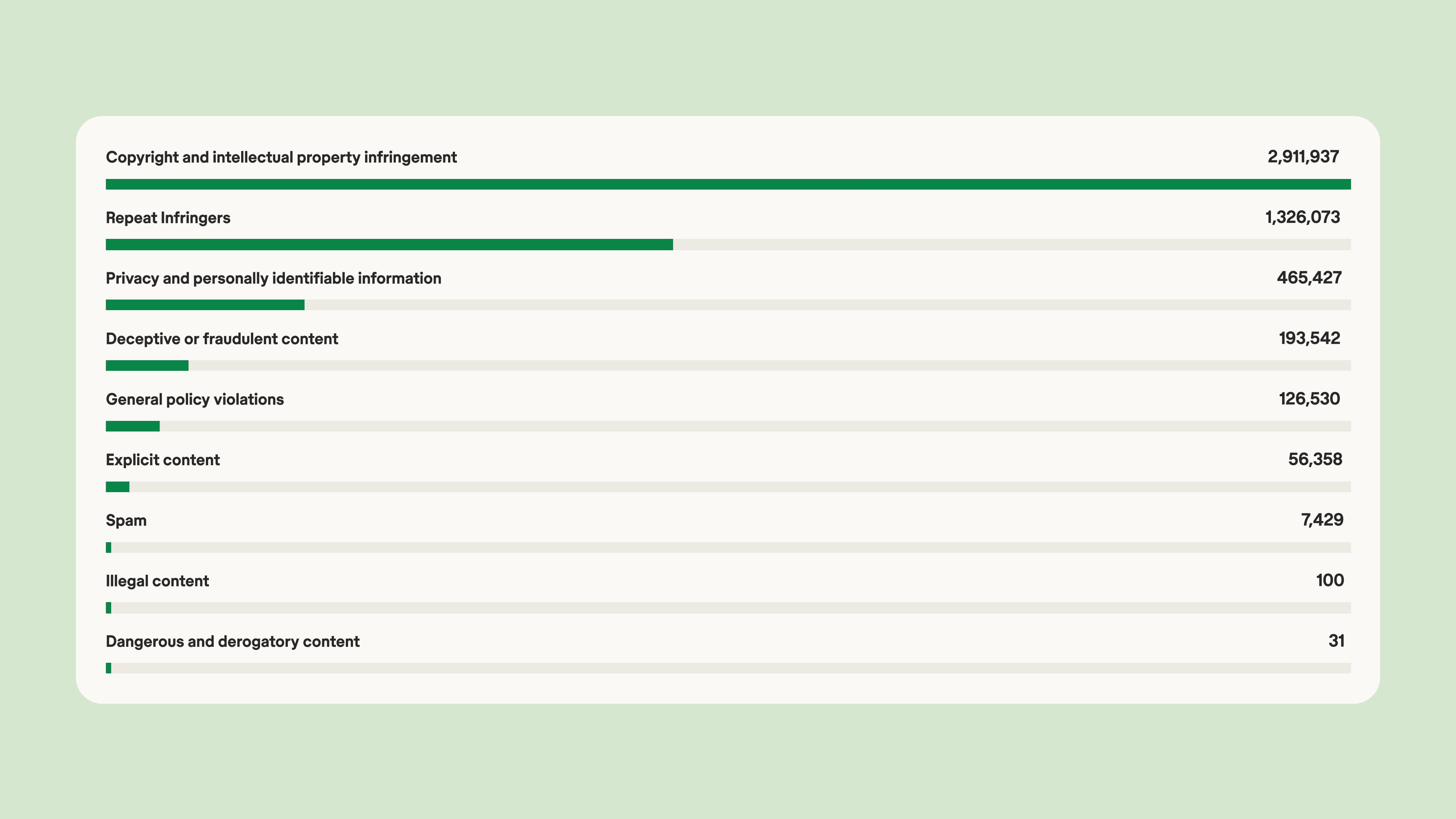
Copyright enforcement: Roughly 2.9M of the 5M removals stemmed from alleged copyright infringement. Scribd's proprietary copyright protection system, BookID™, caught 2.76M of them (~95%) automatically. Scribd also received 48,569 DMCA notices in this period and removed 145,248 pieces of content in response. How to report copyright infringement on Scribd
Content appeals: Scribd received and reviewed 3,539 appeals of content removal decisions, upholding 3,296 (~93%) of original decisions.
Community reporting: Community acts as another arm helping keep Scribd safe. More than 48,000 users submitted 108,638 reports covering 52,359 pieces of content.
Account removals: Scribd terminated 15,355 accounts as part of its repeat infringer policy or for other copyright infringement reasons.
"Scribd only works if people can trust what they find and feel safe sharing what they know. This report puts our enforcement numbers on the record, and it gives everyone a baseline to measure us against in 2027 and beyond." – Mike Lewis, head of Scribd.com
How content moderation works on Scribd
People upload content without pre-approval by Scribd. This allows openness and has helped us build a collection spanning an enormous range of subjects, formats, languages, and use cases.
We have hundreds of millions of users all around the world who come to us for very different purposes. As part of our company mission to advance human understanding, we need to provide an environment where people can share, find, and discuss ideas without putting their safety at risk.
Our Community Rules describe the content that people can upload and publish, including prohibitions on illegal content and other forms of abuse. We use a mix of human and automated methods to review and best ensure the content complies with those rules. And when we find content that violates our policies, we remove it.
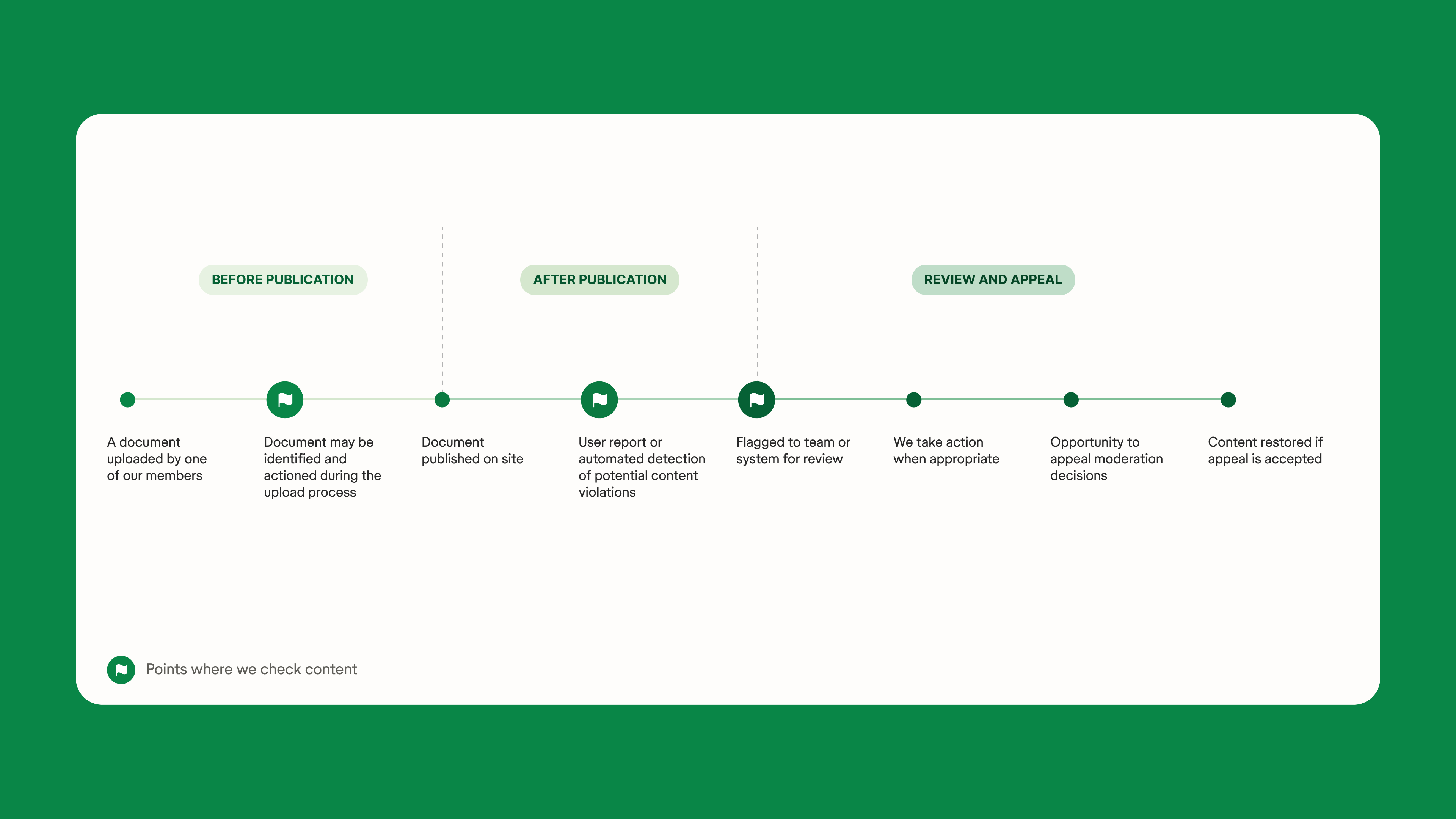
"Unlike many other forms of user-generated content, documents can include a mixture of text, images, different formats, and languages. The average document length on Scribd runs 24 pages. That means we need a layered content moderation strategy, combining technology, human review, and our community." – Nicole Pauls, head of trust and safety
What's next for trust and safety at Scribd
This first transparency report establishes a baseline for how to measure and share this work, and compare future reports against. The next report is expected in 2027.
Scribd will continue to invest in trust and safety, including expanding its team, refining content policies, implementing new technology, and improving content classification.
Read the full Scribd Transparency Report here for more information on Scribd's content moderation work and additional metrics.
Methodology
This is Scribd's first transparency report. It covers the first half of 2026 (January 1 to June 30, 2026). The data includes all content uploaded to or moderated on Scribd and Slideshare worldwide during that period, and every action taken by our automated moderation systems and human review teams.
Frequently asked questions about content moderation on a document platform
Question: How much content does a document platform block before it is published?
Answer: Most of it. Scribd and Slideshare blocked far more documents at upload time with automated tools than they removed after publication in the first half of 2026.
Question: How are copyright violations detected on a document platform?
Answer: Scribd uses BookID™, its proprietary copyright protection system, to identify and limit the distribution of copyrighted works uploaded to Scribd without authorization. By generating digital fingerprints for copyrighted works in its database, BookID scans content, automatically removing matching files. BookID catches the large majority of copyright-related removals automatically. The rest come through DMCA notices and other reports.
Question: Does Scribd have a lot of copyrighted material?
Answer: Scribd does not allow copyrighted material and uses BookID, a proprietary copyright protection system to find and catch unauthorized content before it ever surfaces to users. Scribd removed roughly 2.9M documents for alleged copyright infringement in the first half of 2026. BookID caught 2.76M of them (~95%) automatically.
Question: How does a platform moderate content when uploads don’t require pre-approval?
Answer: Scribd does not pre-approve uploads, which keeps the collection open. Documents can run to hundreds of pages and include sensitive material that is legitimate in context, so Scribd combines automated detection with human review.
Question: How do users report content that violates platform policies?
Answer: Anyone can flag a document for our internal review by clicking “report” on the Scribd document page directly. In the first half of 2026, more than 48,000 users submitted 108,638 reports covering 52,359 pieces of content. When someone believes content on our platforms infringes their copyright, rights holders can send us a valid DMCA notification.
Question: Can users appeal a content removal?
Answer: Yes. Scribd reviews every appeal of removal decisions, and in the first half of 2026 it upheld the original decision in 93% of cases.
Advance human understanding.
Join our team.460 Bryant Street, #300
San Francisco, CA
94107-2594


460 Bryant Street, #300
San Francisco, CA
94107-2594