


Back to school: how students and educators get to the source

For years, students have been taught to show their work. Cite your sources. Check the author's credentials. Compare multiple references. Go back to the original document.
Those habits have long been treated as the building blocks of good academic research. Today they’re becoming something broader: the foundation of how people build trustworthy knowledge in an AI-powered world.
The inaugural Scribd Understanding Index, which surveyed 1,500 U.S. “knowledge builders” about how they research, learn, and verify information, suggests that as AI becomes a routine part of learning and work, the skills traditionally taught in the classroom are becoming more - not less - important.
Students aren’t blindly trusting AI - they’re putting it to the test
Much of the conversation around AI in education has focused on concerns that students will use it to cut corners. The reality appears to be more nuanced.
According to the Understanding Index:
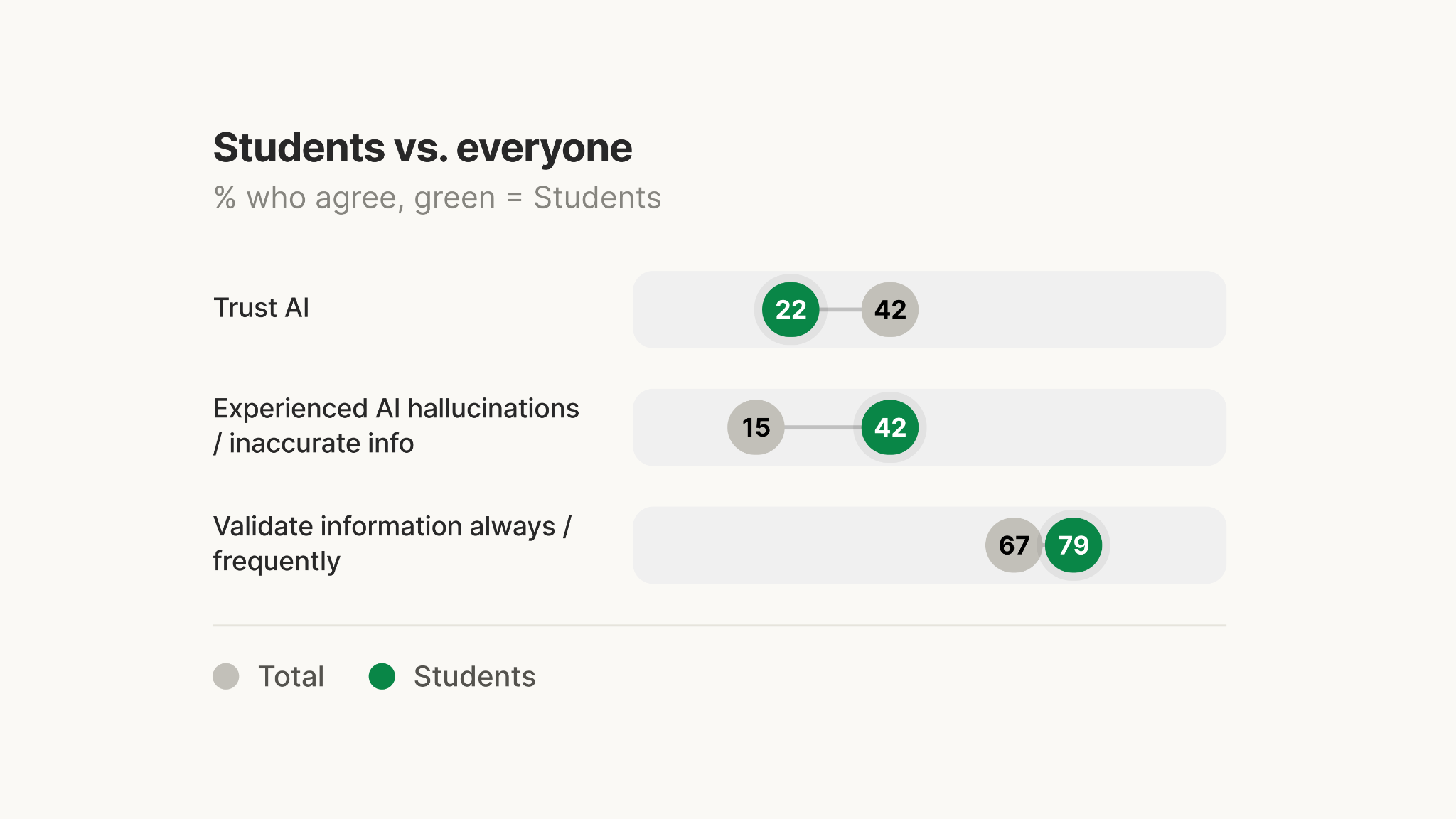
- Only 22% of students say they trust AI-generated information, compared with 42% of the general population.
- Nearly eight in ten students (79%) say they always or frequently verify information
- 91% believe verification is an important part of the research process.
- They’re also more likely than the general population to rely on documents, academic journals, and primary human-authored sources when researching complex topics.
Students are also nearly three times more likely than the broader population to report encountering inaccurate information generated by AI. Those experiences appear to reinforce the importance of validating information before blindly relying on it.
That instinct shows up outside the survey too. A growing number of people arrive at Scribd straight from an AI chatbot and search, landing on long-form documents such as study guides, exam prep resources, and historical deep dives. Someone got an answer and then went looking for deeper context.
Taken together, the findings point to an encouraging trend: using AI isn’t eroding students’ research habits. If anything, it’s reinforcing them and prompting them to lean on original sources.
Educators are modeling that balance
The report suggests educators are approaching AI in much the same way.
Rather than treating it as a final authority, educators are more likely to use AI for brainstorming and initial discovery before turning to original sources to verify information. They’re also more likely than the general public to seek out primary documents and trusted collections of expert content when building confidence in their research.
Educators have long shared their own materials the same way, publishing lesson plans, study guides, and practice worksheets on Scribd and Slideshare so that other teachers and students can benefit from their experience
That work is now finding readers through a new route. When educators turn to chatbots and searches for help building a lesson plan, they are increasingly finding original teaching materials shared by other educators - from academic text structure lessons, to guiding reading worksheets for assigned books. Instructional material is the largest category of study content on Scribd, and demand for it rises each year as school starts.
The workflow reflects a broader shift in how AI transforms into education. It can help people get started faster, but deeper understanding still comes from engaging with evidence, context, and original materials.
AI literacy starts with information literacy
As schools explore what AI literacy should look like, much of the conversation has centered on teaching students how to use new tools effectively. Whether that’s writing better prompts, understanding different AI models, or incorporating them responsibly into assignments.
Those skills matter. But the research suggests they’re only part of the equation.
The habits that determine whether someone can use AI well are often the same ones educators have taught for years like evaluating evidence, recognizing credible expertise, comparing multiple sources, and understanding where information comes from.
Across all respondents, 76% say an author’s expertise is one of the most important signals when deciding whether information is trustworthy, while 72% place similar importance on citations. Human-authored expert documents earned a trust rating of 68, far higher than AI-generated summaries, which scored 18.
The implication isn’t that AI should replace traditional research or that traditional research should reject AI. Instead, the two increasingly work together. AI can accelerate discovery, but original sources become more important, not less as they’re the foundation these tools draw from. The tools will keep changing but understanding still depends on the same qualities that have always defined good learning: curiosity, depth, and grounding in human expertise.
Advance human understanding.
Join our team.460 Bryant Street, #300
San Francisco, CA
94107-2594


460 Bryant Street, #300
San Francisco, CA
94107-2594